Dear California, the Top-2 Is Not the Problem
Many reforms are being proposed for California, but only Approval voting in the primary will address the real issue.
Introduction
The recent California governor’s race held on June 3rd has sparked renewed debate over the state’s Top-2
But why? One reason is that, for a while, there was a serious risk that the runoff for California’s governor was going to be between two Republicans: Steve Hilton and Chad Bianco. Regardless of your party affiliation or ideology, that is objectively a terrible outcome for bright blue California to be represented by a Republican governor in 2026.
In the end, only one Republican, Hilton, managed to make it to the runoff, getting second place with nearly 25%, while Bianco only managed about 10%. Democrats also managed to largely get their act together, and mostly rallied behind Xavier Becerra and Tom Steyer. However, Steyer, who managed a close third place (less than 2% behind Hilton), ultimately fell short. The other percentages give a disturbing picture.
Four candidates managed more than 10% of the vote: Becerra (28.1%), Hilton (24.7%), Steyer (22.8%), Bianco (10.2%). Two more candidates managed to get over two percent: Katie Porter (4.4%) and Matt Mahan (3.5%). Any voters who preferred Steyer over Becerra but voted for Porter, Mahan, or any other nonviable Democrat essentially wasted their vote. Given that the second slot was decided by less than 2%, it’s entirely possible these candidates spoiled the race for Steyer
This introduces one major problem with a choose-one jungle primary: Candidate egos. These candidates knew they had no chance, but stubbornly continued to run, potentially spoiling the race for the frontrunner Democrat they preferred. 61 candidates were on the ballot in this election, and a number of them had dropped out of the race after the deadline to file. Betty Yee and disgraced former congressman Eric Swalwell got nearly 70,000 votes combined, despite dropping out over a month before the election.

A choose-one jungle primary is similar to a system called Single Non-Transferable Vote (SNTV). In SNTV, each voter casts one vote in a multi-member district, and the candidates with the most votes win the available seats. In this context, the runoff has two seats that candidates are competing for
We basically saw this in the California Governor’s race: three serious candidates emerged to compete for the two spots. And voters generally understood this, with over 75% of votes being cast for those three candidates (meaning approximately one fourth of voters had no real impact on the outcome). But there were also a number of spoiler candidates who remained. It should be noted that Cox’s theoretical work often meets with “immediate empirical disconfirmation”
The Real Issue
The true issue is vote splitting. The purpose of a primary is to winnow the field of candidates so that the general election is not plagued by multiple candidates dividing the vote among similar ideologies. That’s why we have party primaries, so that we don’t have eight Democrats splitting the vote while the Republicans consolidate behind two candidates.
A choose-one
What if we have the worst-case scenario of choose-one, and just make that the election?
In California and Washington, which are both blue states that use a system like this, there have been near close calls where Democrats have been locked out. In one Washington election, a Democrat only made it in over a second Republican by less than 50 votes out of over 1.9 million.
This also affects Republicans. In a 2022 California state senate race in a Republican-leaning district, two Democrats advanced with 22.1% and 18.7%, while the remaining nearly 60% of the votes were split among six Republican candidates, preventing any of them from advancing to the runoff. The actual numbers are shocking.
| Candidate | Votes | % |
|---|---|---|
| Tim Robertson (D) | 48,880 | 22.1% |
| Marie Alvarado-Gil (D) | 41,262 | 18.7% |
| George Radanovich (R) | 37,793 | 17.1% |
| Steven Bailey (R) | 37,129 | 16.8% |
| Jeff McKay (R) | 34,773 | 15.7% |
| Jack Griffith (R) | 10,337 | 4.7% |
| Michael Gordon (R) | 6,202 | 2.8% |
| Jolene Daly (R) | 4,652 | 2.1% |
| Total | 221,028 | 100% |
The solution is extremely simple: Keep the jungle primary. Keep the top-2 runoff. But allow voters to vote for multiple candidates in the primary. Empower Californians to support the candidates they like, as well as a pragmatic frontrunner to truly impact the race
The False Solutions
It seems that California will soon face a number of proposed reforms to the current system. Some want to repeal the system entirely, and go back to party primaries. Some want to expand the primary to take the top three or four candidates and then use an alternative method in the general election. But changing just the general election does not solve the underlying issue of vote splitting in the primary.
The pitch of the jungle primary was to make everyone’s vote count, and to defuse the polarization and help broad consensus options and third parties gain influence. But this is simply impossible when voters are limited to choosing a single candidate. They can’t support the consensus compromise or third-party because they have to support a viable frontrunner, or else risk the other major party winning. A number of people I’ve spoken to have realized the optimal strategy: wait as long as possible to cast their vote, and then pick the most favorable viable candidate.
So long as voters are held hostage by restricting their votes to one, these promised benefits–candidates who actually reflect the electorate, viable third parties gaining influence–will never materialize, no matter how many candidates you shove into the general election. The Duvergerian incentives will expand to accommodate the greater number of spots, while preserving the same problematic dynamics. The two major parties will still take all the oxygen from third-parties, and split the three, four, or five slots between them and their many internal factions. It makes no sense to me to think that simply taking more candidates into the general election will solve the underlying issues so obviously caused by vote splitting, which suppress third-party and broader-coalition influence.
Eric Swalwell, who was the former frontrunner, had his campaign implode over the course of about a week, when allegations of sexual misconduct exploded across the media. He dropped out of the race and then resigned from Congress. Because of this, many voters were afraid to vote early, in case another shake-up of this nature occurred.
Under Approval, this calculus changes entirely. People who want to vote early can select all the potentially viable options they like (plus all the nonviable candidates they like too) and trust that at least one of those viable candidates will still be in the race by the time the general election occurs, without having to wait and see who emerges as the frontrunners.
The reforms I have heard for the primary thus far generally entail overcomplicating the ballot. Again, there were 61 candidates on the ballot. Trying to shoehorn
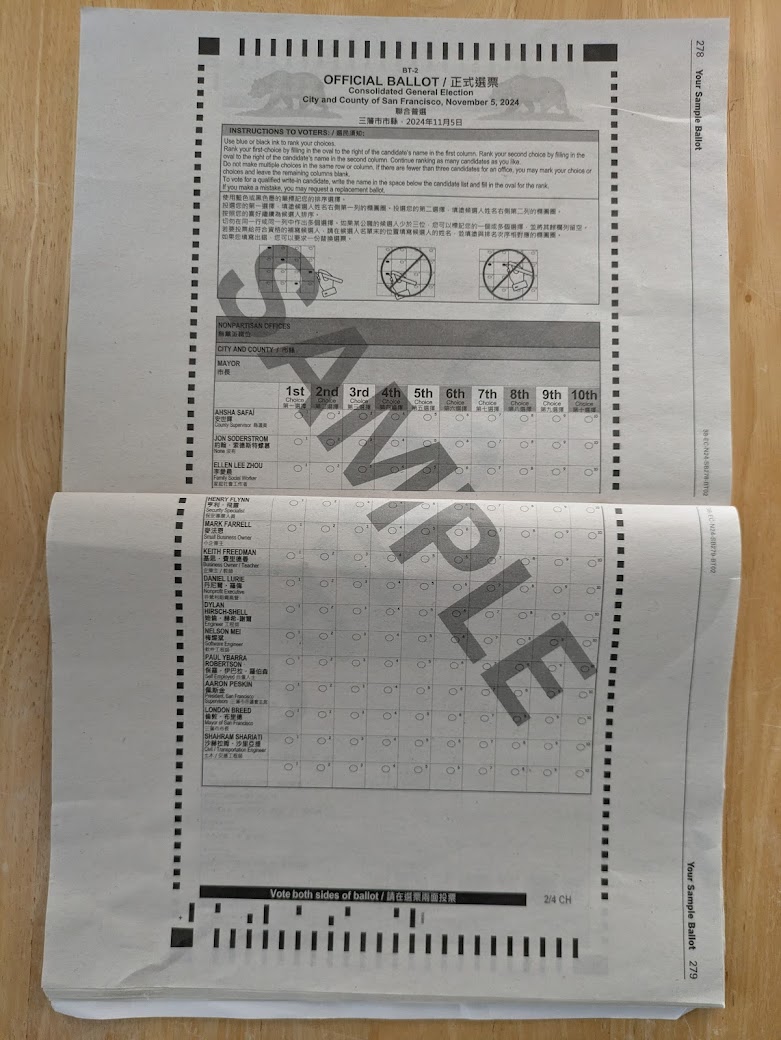
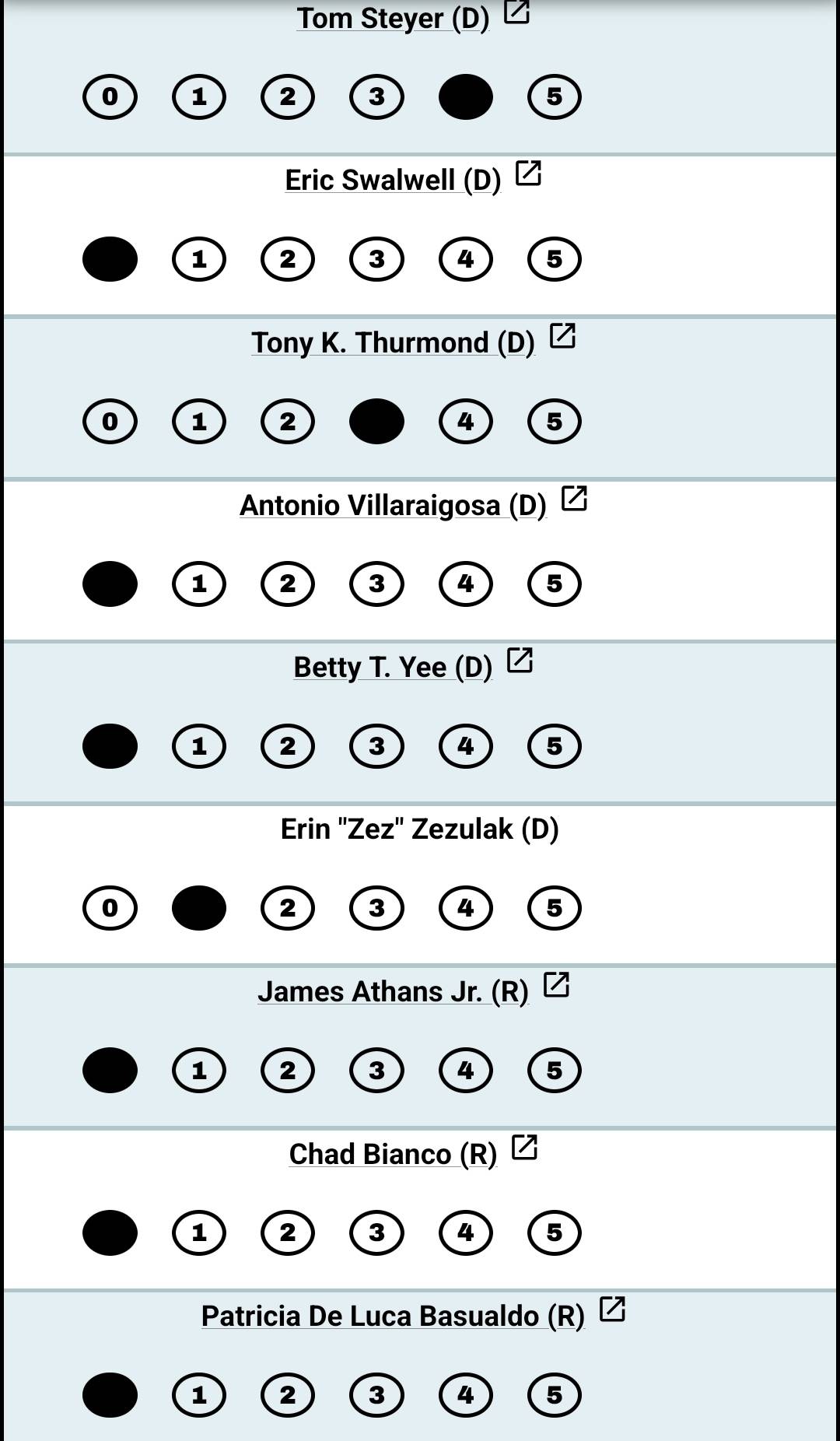
(2) A score ballot (page 1 of 7) from a
We must not get distracted by proposals that either don’t address the core issue of vote splitting or overcomplicate the voting process. The focus should be on practical solutions that fix the problems without forcing voters to endure a hostile ballot.
The Virtues of Approval Top-2
The choice to change the primary to Approval voting would address the core issue, while making the most minimal change possible.
One strong advantage is that this Approval Top-2 system is already in use in St. Louis
Approval Top-2 is also absurdly practical, low friction, and affordable: you need only make minimal wording changes to the ballot, and adjust the settings of the existing election software to count all the bubbles on a ballot instead of rejecting it as an overvote
Candidates would have to actually try to appeal to the widest possible base of voters. At the moment, Democrats are incentivized to fire up their base, since Republican voters are unlikely to turn out in large numbers for any Democrat in the primary. Under Approval, every voter is a possible source of votes, since an approval has no cost and does not detract from their ability to support other candidates.
Voters would then be able to support their favorites, and all the parties and ideologies they want to be viable, while also giving support to a pragmatic frontrunner with far less fear of wasting their vote. Broadly acceptable but underestimated candidates will “bubble up” in the approval counts, gaining visibility and increasing their chances of advancing to the runoff
The runoff also gives every voter an opportunity to distinguish between the frontrunners in the general election. This means voters can be more generous with their approvals than they might otherwise be in a single round system. They can truly support everyone they would be content with, without fear of splitting the vote
What about lockouts?
One potential concern I’ve heard is that implementing this system will lead to a Republican never making it into the runoff ever again, since the majority party will always fill both slots. I used to have this concern too, but I’ve since heard strong arguments that have changed my mind.
For some left-leaning voters, this can be a good or bad thing. For some right-leaning voters, it can feel like disenfranchisement. However, I’d like to give an alternate perspective on this.
Do you think Democrats don’t want a Republican in the runoff? Because they quite enjoy a guaranteed victory. In November 2026, a Democrat and Republican will be on the ballot. But in another sense, the election is already over. I hope you like Xavier Becerra, because unless he suffers a catastrophic accident, he is going to be the next Governor of California and the outcome was decided on June 3rd, 2026.
The hope of the jungle primary in California was to stop the election being decided solely by the primary voters affiliated with the dominant party, and to give all voters a voice in the outcome. But the election is still being decided in the primary, because a candidate with no chance is in the runoff.
Hilton is not a serious contender for Governor, but a sacrificial lamb. If instead the runoff was between Becerra and the other major Democrat Tom Steyer, then all voters, including Republicans, would have a meaningful choice come November.
In such a race, both Democrats would have to try to appeal to Republican and independent voters and earn their votes. They would have to run on and fight for the issues that unite their constituents. This applies to all one-party runoffs, Democrat or Republican, particularly in uncompetitive districts. If one party dominates an electorate, like a state senate district, then a runoff between two members of that party forces the candidates to appeal to the full district.
There is a genuine tension in what is desired for the general election of a top-2 primary system. On one hand, voters want meaningful choices and competitive races that reflect the preferences of the electorate as a whole. On the other hand, voters also want diversity on the ballot, such as having both major parties represented in the general election. We generally cannot have both, with or without Approval. However, Approval firmly moves things towards meaningful choices and competitive races by allowing the most widely competitive and appealing candidates to make it into the general election.
In the race that is going to happen, it’s entirely possible that doubling down on partisan loyalty, and focusing on getting the most motivated partisans to come out and vote against Hilton is going to be the optimal play. As it stands, Becerra has no incentive to govern for all Californians; only for the Democrats who are likely to come out to vote. This is an issue for any non-competitive general election, which is a further reason that Approval’s tendency to deliver competitive and representative candidates is worth the potential cost of diversity in the form of candidates with no actual chance to win.
Approval creates incentives to appeal to the median of the actual electorate
No system that restricts votes can allow a “nursery” effect where such broad but nonviable candidates and third-parties can truly see the depth of their support and eventually become serious contenders
Expanding to more than two candidates may alleviate the lockout problem, but it is not a complete solution. A nursery effect in the general election provides no benefit for the candidates and parties who need it most in the primary. How are they supposed to get into that general election in the first place?
Approval in the primary allows such desirable candidates to accumulate measurable support which influences the perception of what is or is not possible for the next election cycle, potentially paving the way for a more diverse and representative candidate pool in the future.
Conclusion
The simplest possible change to improve the primary system in California is to allow voters to support more than one candidate in the primary election. We don’t need to overhaul the entire electoral system and implement something brand new (addition), but simply repeal the arbitrary restriction on the number of candidates we can support (subtraction). Doing so will eliminate vote splitting, restore genuine voter agency, and fundamentally transform how candidates engage with the electorate.
It requires minimal logistical changes while addressing the core pathology of the current system: the forced choice between sincerity and strategy that leaves millions of voters feeling unheard and elections feeling predetermined.
California has a rare opportunity to lead the nation in electoral reform by embracing simplicity over complexity, and by trusting voters with the freedom to express their true preferences. The question is not whether Approval voting can work–it can, and it does–but whether California has the courage to adopt it. As the state faces yet another election cycle where the outcome feels fixed before the campaign truly begins, that question has never been more urgent.
If you support this change, consider signing this petition!
enjoy this article?
subscribe to be notified of future articles:
and here are some related posts you might like to read next:
- Uncapping the House Doesn't Have to Be Radical
- Strategic Resilience of the Better Choices System
- Better Choices Has a Neat Idea
- The Leader Rule in Approval Voting
- Is Approval Voting Strategyproof?
- Arrow's Impossibility Theorem
- Independence of Irrelevant Alternatives
- Is the Condorcet Winner the True Compromise?
- Why I Currently Only Support Approval
- Approval is the Perfect Condorcet Method
if you found this useful, please cite this as:
Fisher, Taylor Eigen (Jun 2026). Dear California, the Top-2 Is Not the Problem. https://eigentaylor.github.io/blog/ca-top-2/. Accessed Sep 21, 2026.
or as a BibTeX entry:
@article{fisher2026dear-california-the-top-2-is-not-the-problem,
  title        = {Dear California, the Top-2 Is Not the Problem},
  author       = {Fisher, Taylor Eigen},
  howpublished = {https://eigentaylor.github.io},
  year         = {2026},
  month        = {Jun},
  url          = {https://eigentaylor.github.io/blog/ca-top-2/},
  urldate      = {2026-09-21}
}